
Reflection as essential for Lifelong Learning in Europe

ANSE (supported by EASC) calls on the European Parliament to recognize reflective practices, supervision and coaching as essential pillars for a resilient and future-ready workforce.
On 19 November 2025, the message from ANSE, the European network of National Organisations representing more than 10,000 supervisors and coaches across Europe, reached the heart of European democracy. Inside the European Parliament, ANSE addressed parliamentarians and policymakers, through its conference “Developing skills accros Europe in an ever-changing environment”, with a simple but urgent warning: lifelong learning only works when workers are given the space to reflect. Skills alone are not enough.
Moderator Franck Joseph-Maurin opened the conference by saying, “Welcome to this meeting on lifelong learning and how reflective practices, such as supervision and coaching, can truly contribute.” With that, he set the tone for a conversation not about training alone, but about how learning actually happens.
Reflection as a human and professional capacity
In her opening statement, ANSE President Miriam Ullrich argued that reflection belongs to the most valuable human capabilities. “To reflect, adapt and keep on learning is one of the most precious resources we have,” she stated. According to Ullrich, supervision creates the time and structure in which professionals can pause, make meaning from their work and build resilience.
Reflection, she stressed, is not merely a professional method, nor a privilege reserved for specific sectors, but “a genuine human capacity, a social necessity, and a cornerstone of learning communities.” Holding this discussion in the European Parliament, supported by our friends and colleagues from EASC (European Association for Supervision and Coaching) was, she said, a symbolic step: supervision and coaching belong in Europe’s learning ecosystem.
Europe’s labour market: activating informal learning
Professor Andries de Grip of Maastricht University offered a labour market perspective that placed reflective practice at the core of economic sustainability. He outlined how automation, sectoral transitions and new task structures are rapidly redefining European work. According to De Grip, continuous skills updating is no longer optional but a requirement for employability and productivity. Yet the greatest learning challenge lies not in training itself, but in how workers turn experience into competence.
“92% of workplace learning is informal,” he noted. “Reflection is the mechanism that turns everyday experience into usable skill.”
De Grip emphasized that skills deteriorate when unused, while experience-based knowledge deepens over time. That makes reflection critical in a Europe where workers must remain productive for longer careers. He argued that reflective practices such as supervision and coaching enable workers to translate daily problem-solving, trial-and-error and peer collaboration into adaptive capability. Without such mechanisms, organisations underestimate their real learning capacity, while workers face avoidable skill loss and exhaustion.
“Supervision and coaching are not peripheral activities,” he concluded. “They are essential for performance, sustainable employability and a proactive learning culture.”
Reflection in practice: four professional voices
Healthcare and Professional Responsibility
Sandra Postel, President of the Nursing Chamber of North Rhine-Westphalia, showed why reflection is indispensable in a sector under constant pressure. She explained that nurses need reflective time not only to cope with stress, but to safeguard ethical and safe care. “Without reflection, nurses cannot articulate what they need, nor advocate for safe and ethical working conditions,” she said. Reflection, she argued, enables nurses to take responsibility, communicate clearly and make sound professional decisions. Reflective education, she concluded, must become structural in nursing policy, not optional.
Reflection as a Democratic Practice
Elisa Gambardella, President of the Lifelong Learning Platform, linked reflection directly to active citizenship. She argued that Europe’s learning ecosystem extends beyond formal education and that a democratic society requires reflective citizens. “Reflection allows people to understand their reality and take an active part in society,” she emphasized. Reflection, she continued, turns learning into responsibility by connecting knowledge to values and social choices. “Only when policymakers value reflection can lifelong learning contribute to democracy,” she concluded.
Leadership and Education at Risk Without Reflection
Inga Šadurska, supervisor, executive coach and leadership development expert, focused on the pressures facing leaders. “Leaders who do not reflect react. Leaders who do reflect respond with clarity,” she said. She noted that this principle is equally true in education, where teachers and school leaders only develop sustainably when reflection is a regular part of their work. “When budgets are tight, cut training if you must, but never cut supervision,” she added, arguing that without structured reflection, even committed educators struggle to lead and to learn.
Competence Requires Reflection, Not Just Training
Michaela Judy, co-author of the ECVision Competence Framework, warned against confusing skills with competences. “A skill is a task. A competence is a skill that has been reflected on,” she explained. Judy stressed that organisations often invest in training without providing the reflective space needed to transform training into capability. “Reflection takes time and professional support. Without it, organisations may train workers, but they do not develop competence,” she said.
Europe faces a choice
Across the conference, one message became unmistakable: Europe cannot build a resilient and future-ready workforce without reflective practices. Workers who reflect on their work can continue to learn, adapt and grow. Workers who are only trained to perform tasks become vulnerable to change.
Without reflection, lifelong learning cannot be sustained, and workers are unable to continue developing. As the workforce grows less resilient, Europe is left at risk of falling behind.
To secure strong skills, sustainable careers and a future-ready workforce, Europe must invest in reflection. ANSE calls on parliamentarians and policymakers to recognise reflective practices, supervision and coaching as core elements of Europe’s lifelong learning policy.
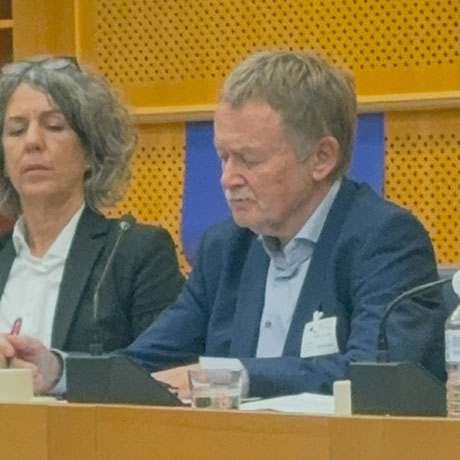

Professional voices
Professor Andries de Grip of Maastricht University
Elisa Gambardella, President of the Lifelong Learning Platform